

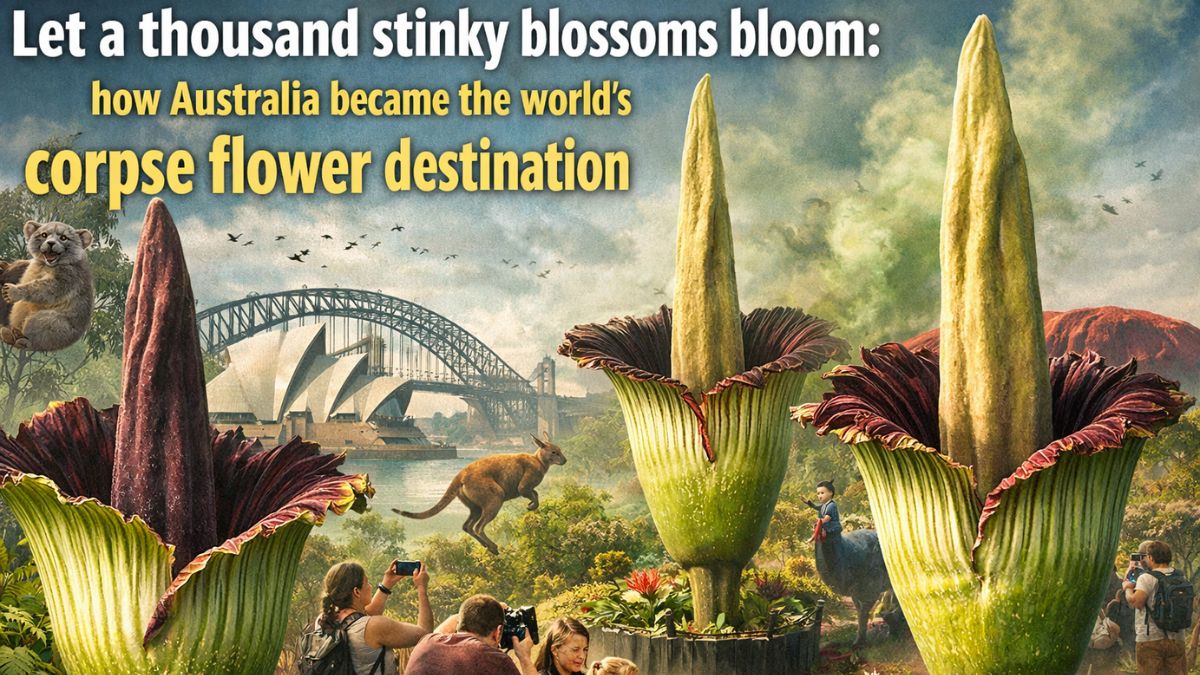
There are flowers that attract with beauty, fragrance, and color, and then there is the corpse flower—one of nature’s most unusual and unforgettable creations. Known scientifically as Amorphophallus titanum, this giant tropical plant is famous for one thing above all else: its powerful odor, often compared to rotting flesh. Despite its unpleasant scent, the bloom draws massive crowds whenever it appears, turning botanical gardens into global attractions almost overnight.
In recent years, Australia has emerged as one of the most exciting places in the world to witness this rare botanical event. From Melbourne to Sydney and beyond, the country has become a hotspot for corpse flower blooming events, attracting scientists, tourists, students, and curious visitors who are willing to wait hours just to experience a moment of nature’s strangest spectacle.
The Mystery Behind the Corpse Flower
The corpse flower is native to the rainforests of Sumatra in Indonesia, where it grows in hot, humid conditions under dense forest canopies. What makes it so fascinating is not just its smell but its entire life cycle. For most of its life, the plant remains dormant underground as a large tuber. Then, after years of slow energy accumulation, it produces either a single enormous leaf or, rarely, a towering flowering structure that can reach over three meters in height.
When the bloom finally opens, it releases a strong odor designed to attract pollinators such as carrion beetles and flesh flies. To humans, however, the smell is overwhelming and unforgettable. The bloom lasts only 24 to 48 hours, making it an extremely rare and time-sensitive event. This unpredictability is part of what makes every flowering such a global sensation.
How Australia Entered the Global Botanical Spotlight
Australia’s rise as a corpse flower destination did not happen by accident. It is the result of decades of investment in botanical science, greenhouse technology, and public engagement with rare plant species. Institutions like the Royal Botanic Gardens Melbourne have played a central role in cultivating and studying exotic plants from around the world.
The country’s climate diversity, strong scientific infrastructure, and commitment to conservation have allowed botanical gardens to successfully grow plants that would otherwise struggle outside their native environments. Over time, these gardens became trusted spaces for rare plant cultivation, including the notoriously difficult corpse flower.
The first major public corpse flower blooms in Australia attracted significant attention, but as more plants matured and flowered, anticipation grew. Soon, every bloom event became a national talking point, covered by media outlets and visited by thousands of eager spectators.
Botanical Gardens as Living Theaters of Nature
In Australia, botanical gardens are not just places for quiet walks or plant collections—they are dynamic living museums where nature puts on a show. The Royal Botanic Garden Sydney and the Royal Botanic Gardens Melbourne have become especially well known for hosting corpse flower events that feel more like cultural festivals than scientific occurrences.
When a corpse flower is about to bloom, staff often monitor it around the clock. The plant can open at any moment, and timing is crucial. Once it begins to unfurl, announcements are made, and visitors rush in large numbers to witness the event. Long queues form outside conservatories, and inside, the atmosphere is a mix of excitement, disbelief, and curiosity.
People describe the experience as both shocking and fascinating. The towering flower structure, combined with its unusual smell, creates a sensory experience that is hard to forget. For many visitors, it is a once-in-a-lifetime opportunity.
Science, Patience, and Years of Preparation
Behind every corpse flower bloom in Australia is years of scientific care and patience. Cultivating Amorphophallus titanum is a long-term commitment. The plant may take anywhere from 7 to 15 years to produce its first bloom, and even then, there is no guarantee it will flower regularly.
Botanists carefully control temperature, humidity, soil composition, and light exposure to replicate the plant’s natural rainforest environment. Any small imbalance can delay blooming for years. This makes each successful flowering a significant achievement for horticultural teams.
Researchers also use these blooms to study plant evolution, pollination strategies, and ecological adaptation. The corpse flower is a remarkable example of how plants can evolve extreme traits to survive in specific ecosystems. Its odor-based pollination strategy is one of the most unusual in the plant kingdom.
Why the World Is Drawn to the “Stinky Bloom”
One of the most interesting aspects of the corpse flower phenomenon in Australia is the public reaction. Despite its unpleasant smell, people are deeply fascinated by it. Social media plays a huge role in amplifying its popularity. Every time a bloom begins, images, videos, and live updates spread rapidly online, turning local events into global attractions.
There is also a psychological element at play. Humans are naturally drawn to rare and unusual experiences, especially those that feel extreme or unexpected. The corpse flower combines rarity, size, and sensory shock into one unforgettable event. It challenges traditional ideas of beauty in nature and replaces them with curiosity and wonder.
Families, students, tourists, and even researchers line up to witness the bloom, often describing it as both disgusting and amazing at the same time. This emotional contrast is part of what makes it so memorable.
Tourism and Cultural Impact in Australia
The growing popularity of corpse flower blooms has also contributed to botanical tourism in Australia. Visitors from across the country—and increasingly from overseas—plan trips around predicted blooming events. Hotels, transport services, and nearby attractions often see increased activity during bloom periods.
For botanical gardens, these events provide an opportunity to engage the public with plant science in a powerful and interactive way. Educational programs often accompany the blooms, explaining plant biology, conservation, and rainforest ecosystems. This helps turn curiosity into learning and strengthens public appreciation for biodiversity.
In a broader sense, these events highlight Australia’s role in global plant conservation efforts. By successfully cultivating rare species, Australian institutions contribute to preserving botanical diversity that might otherwise be at risk in the wild.
The Future of Corpse Flower Cultivation in Australia
As climate conditions change globally, botanical gardens are becoming increasingly important as conservation hubs. Australia’s expertise in cultivating rare plants like the corpse flower positions it as a leader in this field. Scientists are now exploring new ways to improve blooming success rates and better understand the plant’s long dormancy cycle.
Future advancements may allow for more predictable flowering cycles, making it easier for the public to experience the event. At the same time, researchers are focused on preserving the genetic diversity of the species and ensuring its survival in both wild and cultivated environments.
There is also growing interest in expanding educational outreach, using the corpse flower as a gateway to teach people about rainforest ecosystems, pollination, and climate change. Its unusual nature makes it an ideal ambassador plant for environmental awareness.
Conclusion: When Nature Turns Strange, the World Watches
The rise of Australia as the world’s corpse flower destination is a story of science, patience, and human fascination with the extraordinary. What was once a rare rainforest plant hidden deep in Sumatra has become a global attraction, drawing attention not through beauty alone but through its bizarre and unforgettable nature.
From the controlled glasshouses of Melbourne to the iconic gardens of Sydney, each bloom is a reminder that nature is full of surprises. It challenges expectations, sparks curiosity, and brings people together in shared wonder.
In the end, the corpse flower proves that even the most “stinky” blossoms can create moments of pure fascination—moments that turn botanical gardens into stages and transform Australia into the center of one of the most unusual natural spectacles on Earth.
FAQs
Q1. What is a corpse flower?
The corpse flower (Amorphophallus titanum) is a rare tropical plant known for its large bloom and strong smell similar to rotting flesh.
Q2. Why does the corpse flower smell bad?
It produces a foul odor to attract insects like flies and beetles that help in pollination.
Q3. Why is Australia famous for corpse flower blooms?
Australia’s botanical gardens successfully grow and showcase rare corpse flowers, attracting global visitors during bloom events.















Leave a Reply