

Retiring at 62 in Australia 2026? In Australia, by the time one reaches the age of 62, a major question arises: Is your Superannuation savings sufficient for a comfortable retirement? After years of regular contributions, rising inflation, and market fluctuations, the accumulated balance at this age determines your financial stability. Recent figures from 2026 reveal a clear disparity between actual savings and retirement requirements. While some individuals feel financially secure, a significant number remain uncertain about their future. Consequently, understanding these statistics becomes crucial for making the right decisions prior to retirement.
Average Super Balance at Age 62 in 2026
According to the latest 2026 data, superannuation balances vary significantly based on gender and family status. While the average figures may appear satisfactory, the median figures indicate that many individuals are retiring with relatively lower savings.
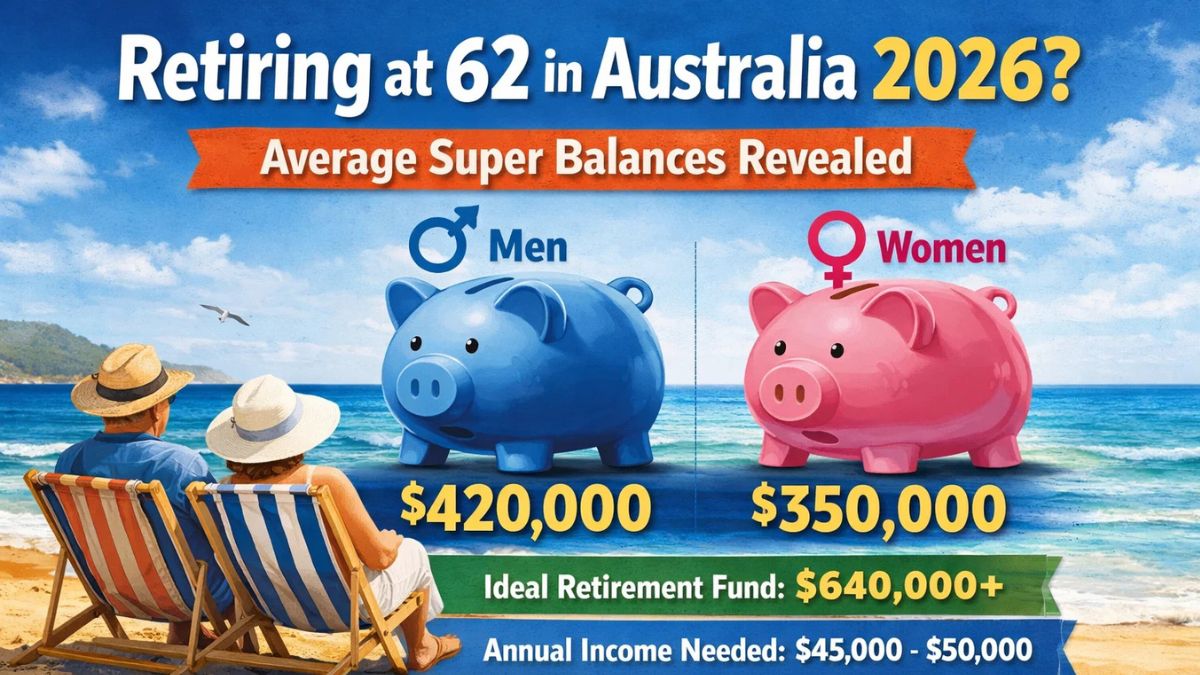
Men in the 60–64 age bracket hold savings ranging from approximately $430,000 to $450,000, whereas for women, this amount typically falls between $330,000 and $350,000. Meanwhile, the combined balance for couples reaches approximately $700,000 to $800,000. However, a startling statistic is that nearly half of all retirees possess savings of less than $250,000—a fact that could become a cause for concern regarding their future.
Why is Age 62 Significant?
The age of 62 is considered a pivotal turning point for retirement planning. At this stage, many individuals begin accessing their superannuation savings; however, certain challenges also emerge.
Although it is possible to withdraw superannuation funds after the age of 60, the Age Pension typically becomes available only at age 67. This implies that for a period of at least five years—between the ages of 62 and 67—you will need to sustain your living expenses solely through your personal savings. If proper planning is not undertaken for this period, your accumulated savings could be depleted rapidly.
How much savings are necessary for a comfortable retirement?
According to financial benchmarks, a comfortable lifestyle requires substantial savings. The exact amount depends on whether you are single or living as a couple.
A single individual typically requires approximately $595,000 to $650,000, whereas for couples, this figure can range from $690,000 to $750,000. If you desire only a modest lifestyle, a smaller amount of savings may suffice; however, amenities such as travel, entertainment, and private healthcare necessitate a larger pool of funds.
Why do women have lower Superannuation balances?
In Australia, the disparity in superannuation balances between men and women remains a significant issue. This gap stems from a variety of social and career-related factors.
Women often take career breaks to attend to family responsibilities, are more likely to work in part-time roles, and generally earn lower average incomes. Furthermore, the reduction in income during parental leave—combined with having less time available for investment—causes their retirement savings to grow at a slower pace.
Income Structure After Retiring at Age 62
If you choose to retire at the age of 62, your primary source of income will be your superannuation savings. Since the Age Pension is not immediately available at this stage, you must rely on your accumulated funds and other investments.
After the age of 60, withdrawals from superannuation can be tax-free, and various “transition-to-retirement” options are also available. However, the risk of market volatility persists, and the retirement period itself can span 25 to 30 years, making meticulous financial planning all the more essential.
Estimating Annual Income from Superannuation
Financial experts generally advise withdrawing no more than 4–5% of your total savings annually to ensure that your funds last throughout your retirement years. If you have $400,000, you could receive an annual income ranging from $16,000 to $20,000. Conversely, with $700,000, this income could range from $28,000 to $35,000. However, many individuals may need to rely on part-time work or a future Age Pension to supplement their income.
The Impact of Rising Inflation in 2026
Although inflation may have eased slightly in 2026, everyday living expenses remain high. Costs for groceries, utility bills, insurance, and healthcare continue to rise steadily.
For those who do not own their own homes, rent poses a significant challenge. Overall, the cost of living in retirement has become significantly more expensive today compared to the past.
The Government’s Perspective: Superannuation and Pensions
The government does not view superannuation as a complete substitute for the pension; rather, it regards it as a supplement. The Age Pension acts as a safety net, while superannuation offers you independence and flexibility.
The Superannuation Guarantee is gradually increasing toward 12%, a trend expected to yield greater benefits for future generations. However, the older generation was unable to fully capitalize on this benefit.
Is Retiring at 62 the Right Decision?
Whether or not to retire at age 62 depends entirely on your personal circumstances. Factors such as your health, lifestyle, housing costs, a partner’s income, and your risk tolerance all play a crucial role.
If you choose to defer your retirement for a few years, your savings could grow, potentially making your future more financially secure.
Essential Steps Before Retirement
Taking certain essential steps before retiring at age 62 is absolutely critical. First, review all your superannuation accounts to determine your total balance. Use a retirement calculator to project your future financial needs.
If feasible, consider downsizing your home and ensure you have a thorough understanding of the eligibility criteria for the Age Pension. Most importantly, consult a financial expert. It could prove beneficial for you.
Conclusion:
Retiring at the age of 62 is a major decision that depends entirely on your overall financial plan. With the right information, sound planning, and timely decision-making, you can make your retirement secure and comfortable.
FAQs
Q. What is the average super balance at age 62 in 2026?
A. Men have around $430k–$450k, women $330k–$350k, and couples about $700k–$800k.
Q. Can I access my super at age 62?
A. Yes, you can access your super after age 60 if you have retired.
Q. How much super do I need for a comfortable retirement?
A. Singles need about $600k+, while couples need around $700k+.











Leave a Reply